|
|
sculptor painter innovator
ARMAND VAILLANCOURT

by
ROBERT J. LEWIS
___________________________________________________________
Armand
Vaillancourt made the cover of Newsweek in 1973.
His works have been featured twice in Time Magazine.
In 1967 he won Canada’s Governor General’s Award.
He was commissioned by the City of San Franscisco (1967-1971)
to design and supervise the construction of the world-famous
Vaillancourt Fountain. But the sum of these deserving recognitions
tells nothing of the artist’s imagination or how it
informs his inspired approach to being-in-the-world.
 |
When
it comes to post-modern art, I was as skeptical as the next
person until Armand Vaillancourt invited me to see his work
which overfills the many rooms of his home on Esplanade
St. in Montreal, as well as the huge installations crammed
into his ample yard. However, it was only after the art
had been viewed and we were well on our way to a nearby
café, that what I call the Vaillancourt-effect began
to take hold.
Keeping
up with hyperactive and agile 74 years old Armand Vaillancourt
is a fast-walk, sudden-stop affair. “Look at this,”
he says with a child’s delight in discovering the
endlessly fascinating world around him. Armand is admiring
two vaguely opposed dents in a less than pleasant smelling
municipal garbage can. “Imagine painting the first
dent in red, the second yellow, the barrel in black and
putting it on a revolving stand. It would be beautiful.”
Come on Armand, I say to myself. That’s not art. A
minute later he stops again. “Look over here.”
He’s now admiring the grain on a wooden window sill
where the paint has peeled back. “Isn’t it beautiful,”
he says, not particularly interested in whether I agree
or not, so enraptured is he by it. “Imagine it ten
times its size, in a museum. Everyone would stop and look
at it.”
Three
or four art-stops later, we finally arrive at his favorite
café on the corner of St. Laurent and Rachel.
The
magic and majesty of Armand Vaillancourt lie in his refusal
to accept the ugliness and banality of the things of the
world. Through the imaginative technique of recontextualization,
he makes us understand that the beauty we overlook is not
a fault of the thing itself but rather a shortcoming in
ourselves. His example inspires us to take responsibility
for our imagination (the body’s most under-exercised
muscle), and by extension, the aesthetic state of affairs
of the world. If most industrial waste is geared to recyclage,
Vaillancourt expropriates what are ordinarily regarded as
uninteresting, utilitarian objects – from rusted-out
lathes to rotted tree trunks to junked car hoods –
and resituates them in order to elicit their purity, their
symmetries, the harmony of their parts, their natural beauty.
Spend a day with Vaillancourt and he will have you believing
there isn’t anything that can’t be rendered
beautiful, such is the power of the artist to transform
our world.
Among
Vaillancourt’s most innovative and magnificent works
are his bronze sculptures from the 1970s made from Styrofoam
moulds and cast in the lost wax technique.
The
sculpture La force (1966) is located in Mount
Royal Park, near Beaver Lake. This cast-iron piece is
noted for its textured, industrial surfaces and raw, expressive
materiality.

Musée
d'art contemporain de Montréal
The MAC holds various works by Vaillancourt as part of
its permanent collection, representing his pivotal role
in Quebec's modernist and abstract sculpture movements
of the 1950s and 60s.
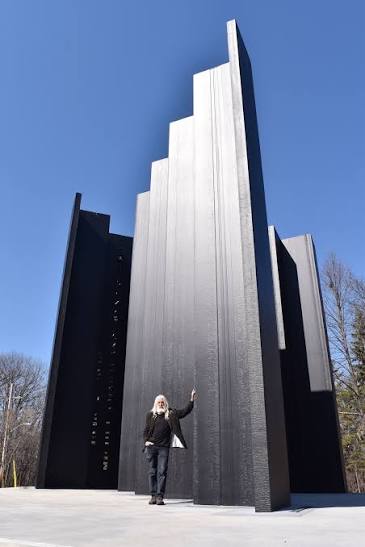
Parc
Michel Chartrand -- Longueuil. La Force d'Ouvriere
READER FEEDBACK
|
|
|
 |
 |
 |
 |
|
CLICK AD↓ : SUPPORT
A & O
|
|
|
|
|
|
|


